

Assisting Accredited Investors Across the Globe

(913) 283-7804

Mon - Fri: 9:00 a.m. - 5:00 p.m. CST

Home / Investment Newsletter / Monthly Investment Newsletter – April 2026

Monthly Investment Newsletter - April 2026

SLF Investments (SLF) is a private equity investment company with 20+ assets under management that generated ~$100 million in revenues during 2025. 

The Supply Gap Is Locked In

For the last two years, the senior housing investment narrative has been defined largely by recovery. Occupancy has steadily climbed as demand has returned. However, framing the sector as “recovering” no longer captures what is happening. A more important shift is now underway – one that has less to do with where the market has been, and more to do with where it is going.

Senior housing is moving toward being defined by constraint.

While demand has returned, supply has quietly stalled. The future pipeline of new development has already been materially reduced. This is the key point investors are beginning to recognize:

The supply gap isn’t coming, it is already locked in.

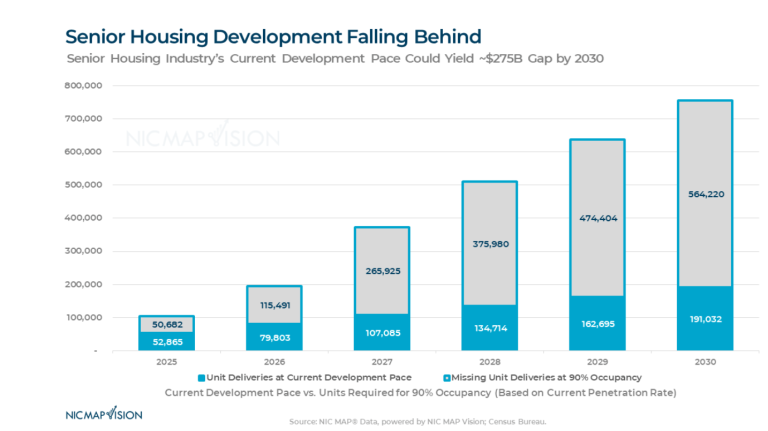
Senior housing Development Falling Behind - 275B Gap by 2030 - SLF Investments - Source NIC MAP Vision

A Market Moving Into Imbalance

At a surface level, the senior housing sector continues to post strong operating fundamentals.

Occupancy across the industry has approached the high 80% to 90% range, marking a continuation of one of the longest recovery streaks on record.

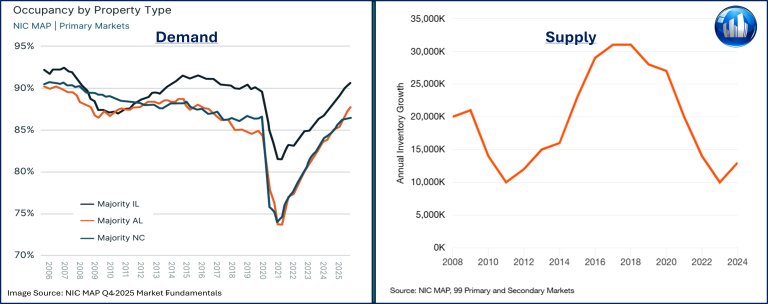
The underlying fundamentals remain compelling. NIC MAP reported that overall senior housing occupancy reached 89.1% in the fourth quarter of 2025, with independent living at 90.6% and assisted living at 87.7%. Annual inventory growth was just 0.6%, while construction sat at only 2.3% of inventory.

Senior Housing Supply Demand Disparity 2026 - SLF Investments - Private Real Estate Investment

At the same time, rent growth has stabilized in the mid-single-digit range, reflecting both improving demand and the ability of operators to push rates without materially impacting absorption.

Individually, these are positive signals. Historically, periods of rising occupancy tend to trigger a corresponding increase in development activity. As properties fill and rents rise, new supply enters the pipeline, eventually restoring equilibrium.

That cycle is notably absent today.

Instead, the industry is experiencing something far less common: demand recovery without a meaningful supply response.

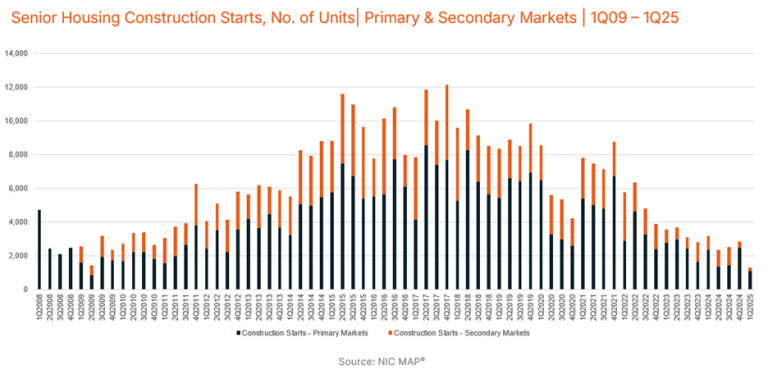
Senior Housing Construction Starts - Q1 2025 - Source NIC MAP - SLF Investments

Inventory growth across many markets has slowed to a near standstill. In some cases, new supply as a percentage of existing inventory has fallen to levels not seen in over a decade.

This slowdown is not the result of a single factor, but rather a convergence of constraints:

  • Elevated construction costs that remain well above pre-2020 levels
  • Higher interest rates increasing the cost of development financing
  • More conservative underwriting standards from lenders
  • Longer construction timelines, often extending well beyond historical norms

Taken together, these factors have made new development meaningfully more difficult to execute.

Fewer projects are breaking ground, those that do are taking longer to complete – and many proposed developments are being delayed or shelved entirely.

It is important to note that in real estate, particularly senior housing, supply is not determined in real time. It is determined years in advance.

Why the Future Is Already Determined

One of the most misunderstood aspects of real estate investing is the timeline between decision and delivery.

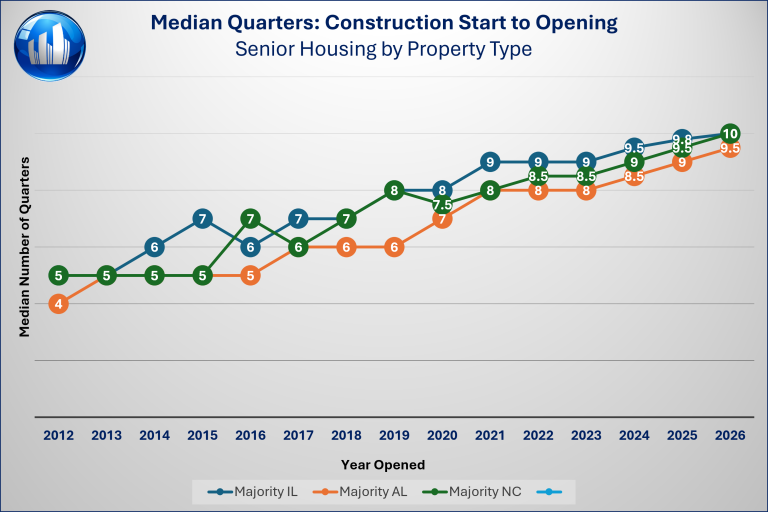
From initial planning to final stabilization, a senior housing development can take anywhere from two to four years – or longer in more complex markets. Supply that will enter the market in 2027, 2028, and even 2029 is largely a function of decisions being made today. Senior housing construction timelines have doubled over the past decade. Growing from 5 to 10 quarters for average completion from construction start date.

Senior Housing Construction Timeline - 2026 SLF Investments - Private Investment Company - Data Source NIC MAP
SLF Investment Community Healthcare Employees

Senior housing completions have declined by approximately 73% since 2021- while demand has continued to accelerate. When development slows, the impact is not immediate. Existing properties continue to operate. Occupancy continues to rise. At first glance, the market appears stable. However, beneath the surface a gap begins to form.

From Occupancy Growth to Pricing Power

As the market has moved into this type of imbalance, the implications have extended beyond occupancy and into pricing. When available units become increasingly scarce relative to demand, operators gain leverage. Rent increases can be implemented with greater confidence, concessions become less necessary, and occupancy stabilizes at higher levels. Most importantly, incremental occupancy gains begin to translate more efficiently into net operating income. In a constrained supply environment, operators are not only filling units – they are doing so at higher rates.

The result is a compounding effect:

  • Higher occupancy
  • Higher rents
  • Improved operating efficiency

Together, these factors drive meaningful NOI expansion.

Implications for Valuations and Capital Flows

As operating fundamentals strengthen, the impact extends beyond property-level performance and influence valuations. In commercial real estate, asset values are largely a function of income. As net operating income increases, valuations tend to follow – particularly when supported by stable or improving cap rate environments.

Recent data suggests that pricing clarity is beginning to return to the senior housing sector. Transaction activity, while still below peak levels, has shown signs of stabilization. The bid-ask spread between buyers and sellers has narrowed, indicating a growing alignment on valuation expectations.

Operational Example: Bloomington, IL

SLF Investment Community: Bloomington, IL

Throughout 2025 and entering 2026, SLF’s investment in Carriage Crossing Senior Living – Bloomington continuing to demonstrate the value of stabilized operations and disciplined execution. The property grew revenue by 2.7%, increased NOI by 4.2%, maintained occupancy in the 95%+ range. These factors allowed the property to achieve 102% of target exit NOI.

SLF reports that the community is well positioned to maintain stabilized occupancy and remain at or near target exit NOI through the year, supported by leadership retention, low staff turnover, quality programming, and strong resident satisfaction.

Aerial Photo of Senior Housing Investment Community in Bloomington Illinois - SLF Investments
SLF Investment Community: Bloomington, IL

Want To Participate in a Growing Sector?

SLF Investments (SLF) is a private equity investment company with 20+ assets under management that generated ~$100 million in revenues during 2025. If you would like to hear about our current offerings, contact our investor relations team today!

Our Team.

The Senior Living Fund investment team is comprised of industry, securities, financial, and investment experts, as well as support personnel, based primarily in the Kansas City metropolitan area.

SLF Executive Team.

Dan Brewer, Founder & Chief Fund Manager

Dan has 30+ years of business experience, including 25+ years as an executive and principal in real estate, capital placement, business development and management. Dan has 10+ years of experience in a business consulting and management role for Accenture. Dan also has 10+ years of experience in the senior housing sector.

Mark Shader, Chief Operating Officer

Mark brings strong operations management skills to the SLF team through his 30+ years of experience in business consulting, real estate investment and development, financial analysis and management. Mark currently serves as Chief Operations Officer for Senior Living Fund, LLC and its affiliated entities.

Rick Maner, Chief Financial Officer

Rick brings over 30 years of financial management experience, mostly focused on financial services industry. Rick oversees all of the accounting operations including financial reporting, cash planning, and managing external audit relationships and the Funds tax reporting.